Nothing compares to the passion of High School Sports. But these contests deliver much more than the games themselves — public school athletics unite communities and help shape our future leaders by teaching resilience, commitment, and what it means to be part of a team.
Sustaining these programs takes resources, and today’s financial landscape is making that harder than ever. As costs climb and traditional funding sources fall short, school systems are being pushed into increasingly difficult decisions that jeopardize opportunities for student-athletes across our country.
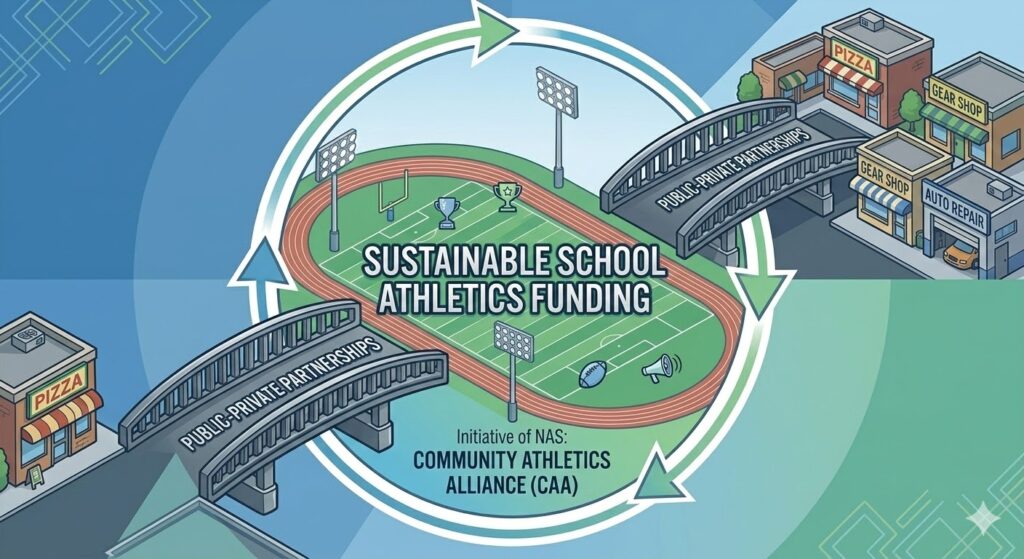
But there is a solution. The Community Athletics Alliance (CAA), an initiative of National Amateur Sports (NAS), is the first program of its kind that brings a simple and sustainable solution to this complex problem.
Did you know that high school sports are the largest sports market in the USA? If you combine all the fans that attended events at the four major professional sports leagues (NFL, NBA, NHL & MLB), you still wouldn’t reach the attendance at High School events, which is more than 500 million people annually! So, if there are that many fans, why aren’t businesses lining up to sponsor? Well, they are, they just don’t have an easy way to access the market because it’s so fragmented.
That’s where NAS and the CAA come in. By creating partnerships with School Districts, NAS consolidates the fragmented market and makes it easier and more valuable for businesses to engage. The CAA provides business partners year‑round engagement, millions of impressions, and most importantly, authentic engagement with the local community. This exchange of value is what creates the solution and why this program can not only sustain public school athletics but also allow them to prosper and grow.
Building a Stronger Community Ecosystem
One of the biggest problems with the current funding model in Public School athletics is that it relies almost exclusively on fundraising and donations. While some schools in more affluent areas can meet the financial needs to operate their programs, many more schools cannot, which results in the large discrepancies in equipment and facilities that we see from one school to the next. One of the greatest benefits of the CAA and its District-Wide approach is that the financial support can be distributed back to schools equitably, allowing all schools in the district to thrive.
As Darryl Nance, District Athletic Director of Greenville County Public Schools, noted, these District partnerships provide “support for different schools that may not be able to raise as much as another one.” He emphasizes that this is not just a one‑off sponsorship. Instead, “It’s an investment into a community support system that drives the public-school athletic system. It’s a phenomenal opportunity.”
For the businesses that support this initiative, it’s worth much more than the brand impressions it provides; the real value is the brand goodwill that is created. The kind that comes from championing equity and opportunities for kids across the community. The CAA recognizes the partners whose funding is making a difference and giving them recognition all year long, everywhere that fans engage. Bottom line, countless studies prove that if you support people’s children, they will return that support at very high levels.
*Source: YouGov National Study on Youth Sports Sponsorship: 80% of parents say they are more likely to choose a brand that sponsors their child’s team or league at the point of purchase
Funding Technology and Innovation
Strategic partnerships, facilitated by the CAA, enables funding and resources to implement innovations that create efficiencies for staff and open new engagement opportunities for the community.
Deran Coe, District Athletic Director of Wake County Public Schools, shared how NAS and the CAA “keep their finger on the pulse of some of the changing technologies… and also some of the opportunities for public and private partnerships to help fund the things that we want to do.”
A key example was the quick pivot during the 2020 pandemic. “Thanks to our partnership with NAS, we already had live streaming cameras embedded in all of our stadiums,” Coe explained. “So, it was a quick flip of a switch to be able to continue to keep our communities engaged.”
These innovations don’t just benefit schools — they give partners expanded digital reach, high‑value impressions, and consistent visibility across platforms families use every day. It’s a modern, scalable way for businesses to stay connected to their community.
Leveraging Partnerships to Tell a Story
Effective partnerships do more than provide funds; they also give districts a platform to share their story. Through the CAA, districts have a voice to showcase the impact of their athletic programs. This visibility gives current partners the recognition they deserve but also makes it easier to attract new supporters.
“Our partnership with NAS to me is about us being able to tell our story, and the impact we have on students and the community,” said Tom Horn, District Athletics Director of Fairfax County Public Schools. He explained that “everyone values what we do, but they need a way to support that effort”, which is what the CAA is all about.
For partners, this storytelling and the impact of sports on students is what creates the authentic engagement — it’s not just logo placement on a website or banners on fields, it’s positioning the partner businesses as active contributors to student success, which strengthens loyalty and builds a long‑term community connection.
A Sustainable Model for the Future
Through the CAA, partnerships become a powerful engine for strengthening and sustaining athletics — they deliver meaningful and measurable value for businesses, higher engagement with communities AND reliable support for schools and athletes that they desperately need.
It’s a win‑win…win model!